


Introduction
It is critical to know the difference between stable and unstable diffusion. This helps us appreciate the shifts in AI picture production. Soon after its release, the model being discussed here, Stable Diffusion from Stability AI, obtained its notable number of downloads, topping the 10 million mark within a month. Also, unstable diffusion raises the variability and randomness of work. It also increases the rate of unreliable results. This blog will focus on the technical gaps and uses of diffusion models. I will discuss their unique aspects in generative AI.
Also Read: What is the Water Jug Problem in AI? Easy to Understand
History
It is possible to use Stable Diffusion and its unsuitable twin, Unstable Diffusion, to improve generative AI, particularly in the field of picture synthesis.
Stable Diffusion, created in August 2022 by Stability AI and Ludwig Maximilian University researchers, employs a latent diffusion model. This model enhances noisy images and creates images from text. It improves stability and quality, reversing noise added during training. Additionally, it builds on earlier methods, especially GANs. The source code is free to use. Thus, developers are able to incorporate it into their applications.
Unstable diffusion, less commonly discussed, refers to older generative models. They had problems with quality and stability. Due to unpredictable results, developers created more accurate models, like Stable Diffusion. This shows that AI-driven picture-generating tech is growing fast. It is due to the shift from unstable to stable models.
Also Read: What is Pandera in Python? Check Examples and How to Use It
What is Stable Diffusion?
In 2022, Stability AI released Stable Diffusion. It is the newest generative AI model. It uses a hidden spread approach to create clear images from script prompts. It generates one set of integrated visual outputs. The generative model is trained to reverse a noise process. It does this by, via consistent training on a large dataset of image-text pairs. It gradually transforms noise signals into images.
Stable Diffusion is shareware. Thus, customers can install and execute it on consumer hardware if needed. The following is not like previous proprietary models. It can do more than generate images. It can paint and translate pictures, too. This is revolutionizing operations in almost all sectors of the economy.
Features of Stable Diffusion
- Deep Learning Model: Stable Diffusion is a generative AI model that can transform text into images using latent diffusion processes.
- Open Source: They can freely use it on consumer hardware with at least 4GB of VRAM.
- Image Generation: Effective in generating highly detailed images as a result of input text prompts and modifying original images through completion and removal.
- Architecture: To improve the efficiency of the current architecture, U-Net, a Variational Autoencoder (VAE), and an optional text encoder have been used.
- Versatile Applications: Can accomplish a variety of functions, including semantic synthesis and video synthesis.
- User-friendly: Does this increase creators’ accessibility by allowing them to run it either locally or through cloud services?
Also Read: What are Small Language Models and how do they work?
What is Unstable Diffusion?
Unstable Diffusion is the top AI image generator now. It quickly creates images using diffusion models. Unlike Stable Diffusion, it aims for raw, unrefined outputs. These outputs can be noisy and random. The tool employs PixelCNN++, a neural network. This network generates unique designs from simple user prompts. It’s free and popular, especially among artists and developers seeking new imagery. Users can easily tap into their creativity online, making it widely accessible.
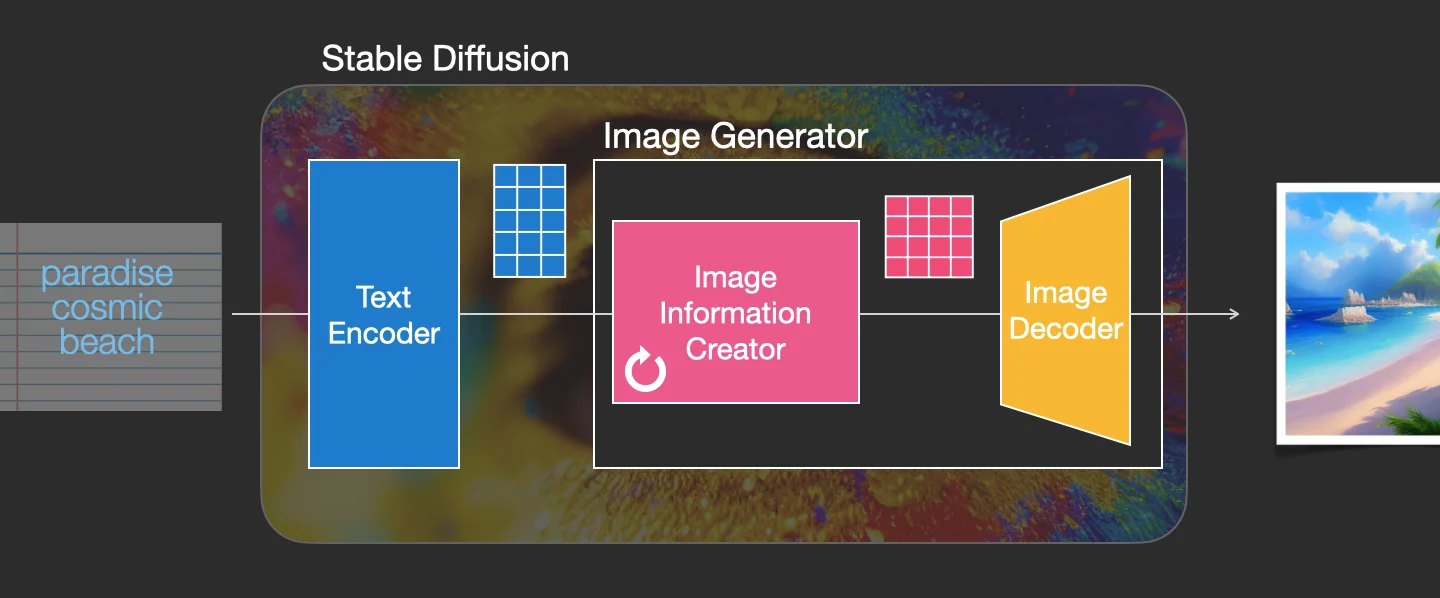
Source: jalammar.github.io
Features of Unstable Diffusion
- Diffusion Modeling: Creates images from complex diffused schemes, as shown in the chapter.
- Extensive Training: Training on more than 100 million photos increased the amount and quality of the output.
- Text-to-Image Generation: Creates distinct pictures derived from complex written descriptions, compatible with realism, cartoons, and abstractions kinds of pictures.
- User-friendly Interface: Some features are available for free, with others requiring a subscription from paid accounts; they can be run in web browsers without requiring downloads.
- Customization Options: As for parametric features, users have prefixed options to shift regarding style, composition, and color scheme.
- Open Source: Encourages creation and exploration of AI art by the general public because anyone can do it.
Also Read: What is Scribble Diffusion? How Does It Turn Doodles and Sketches to AI Images?
Difference Between Stable and Unstable Diffusion
A key contrast of stable vs unstable diffusion is their generative AI models. They are very different. There are significant differences between the two generative modeling paradigms, especially for AI. There are minor differences between stable and unstable diffusion methods. These are briefly described below, along with the strengths and weaknesses of each in real-world generative AI.
| Feature | Stable Diffusion | Unstable Diffusion |
| Mechanism | Operates in latent space, enhancing speed and reducing computational costs. | Often struggles with maintaining stability during the generation process. |
| Output Quality | High-quality, detailed images that closely match textual prompts. | Outputs can be inconsistent, requiring multiple attempts for satisfactory results. |
| Training Efficiency | More efficient due to reduced dimensionality in latent space; faster convergence during training. | Less efficient, often needing extensive training data and time to stabilize outputs. |
| User Control | Provides tools for users to customize models and outputs easily. | Limited user control over the generation process; outputs can vary significantly based on minor input changes. |
| Applications | Widely used in creative fields for generating art, illustrations, and various media formats. | Less common in practical applications due to unpredictability; often used in experimental settings. |
| Community Support | Strong community with numerous resources and pre-trained models available for public use. | Limited community engagement; fewer resources available for troubleshooting or customization. |
| Examples of Use Cases | Text-to-image generation, inpainting, outpainting, guided synthesis. | Mostly theoretical or experimental applications; not widely adopted commercially. |
How Does Stable and Unstable Diffusion Work?
Stable Diffusion is a deep learning system that creates art from text. Its core is a Variational Autoencoder (VAE), with a U-Net decoder and sometimes a text encoder. The VAE captures images in a feature space called latent space. This space is affected by Gaussian noise during the forward diffusion phase. Then, the U-Net removes the noise iteratively to form the final image.
Unstable diffusion models might require a more systematic approach, unlike stable ones. Sometimes, poor noise handling or inadequate training leads to low-quality results. Unstable diffusion affects image coherence and quality. In contrast, stable diffusion focuses on strong denoising. It also samples based on input texts.
When stable vs unstable diffusion is compared, main differences in visual clarity and their link to input cues. Unstable diffusion has a less reliable network and produces unpredictable, often lower-quality output. In contrast, stable diffusion consistently delivers high quality, meeting customer needs. This shows that architectural design is key to success in generative deep-learning models.
Step by Step Process of Using Stable and Unstable Diffusion
To effectively use stable vs unstable diffusion, it is mandatory to understand the distinct characteristics and appropriateness of each of the mentioned models. This is a step-by-step guide on how to use both models.
Step 1: Knowledge of the Models Acquired
- Stable Diffusion: A deep learning model known as stable diffusion was developed to generate high-quality photos in response to text prompts. For example, it employs what is termed latent diffusion, which, while conforming to social norms, allows the creation of realistic and terrific images.
- Unstable Diffusion: On the other hand, there is Unstable Diffusion, an experimental type that allows more freedom within the artwork but often results in lower graphics quality. It is also famous for creating material that others have banned and for making other types of materials regarded as forbidden.
Step 2: Configuring Your Space
- Stable Diffusion: Check your GPU compatibility and ensure the GPU has at least 4GB of VRAM for stable diffusion. Then, download the model from its source and follow the installation steps to deploy it to your local machine.
- Unstable Diffusion: Unstable Diffusion can be accessed from within your web browser and does not need to be installed. This created model is easy to experiment with because it falls under an open source and is free for use.
Also Read: NLP vs LLM: What are the Chief Differences Between Them?
Step 3: Producing Pictures
- Using Stable Diffusion:
- Explain to the model a long text.
- To achieve a better result, modify settings concerning resolution or style.
- There is also an option to run the model to generate high-quality images to meet your needs.
- Using Unstable Diffusion:
- Type an imaginative or global creative story title.
- Experiment in different environments – do not forget the fact that it may be less standard.
- Output images rapidly accept the model’s implied capability to yield various, quite peculiar results.
Step 4: Assessing Results
Compare the pictures derived from the two models. Thus, Unstable Diffusion may generate different peculiar or avant-garde images, which can contribute to creative actions. Still, the result of Stable Diffusion looks polished and can be helpful for commercial needs.
Through such actions, users will be able to distinguish between stable and unstable diffusion properly and use the benefits of both models depending on their needs and the goals and purposes of the artworks they wish to create.
Conclusion
It is vital to understand the difference between stable and unstable diffusion. This is true for many key areas of science, especially the technical sciences. Stable diffusion is ideal for processes that require strict control, like medicine delivery. In contrast, random diffusion can be helpful. It can create a fast mix or reaction rate. But, it can also have unpredictable effects. This will help researchers and practitioners adapt their strategies. They can then exploit the various qualities of each diffusion type.
For more information on AI, click on the links given below: