Explore the groundbreaking strides made by tech giants like Google and IBM in the realm of quantum computing, a technology pushing the limits of knowledge, as it promises to solve problems in minutes that would stymie today's supercomputers for millions of years.
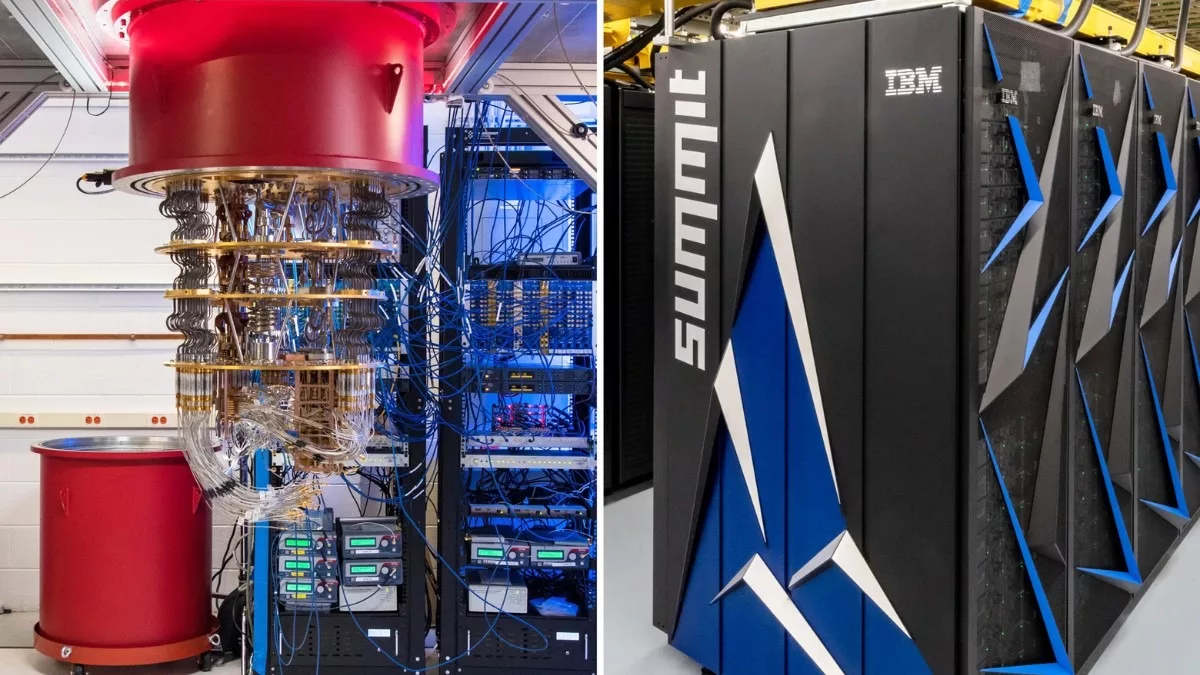
IBM and Google Quantum Computers
Quantum computing represents a paradigm shift from classical computing, as explained by Dario Gil, head of research at IBM. Quantum computers leverage the principles of quantum physics, abandoning traditional transistors to encode information on electrons behaving in complex ways. Unlike classical computers that handle one bit at a time, quantum computers process exponentially more data by examining all possible angles simultaneously. The potential of quantum computing is staggering, with the ability to solve complex problems in physics, chemistry, engineering, and medicine.
Must Know: What Is Google’s New Generative AI Tool To Find Holiday Gifts?
IBM’s Quantum System Two, set to be unveiled, boasts three times the qubits of its predecessor, signalling rapid progress. Gil expresses confidence in reaching systems with tens of thousands or even a hundred thousand qubits, underlining the transformative journey ahead. Quantum pioneer Michio Kaku likens the development to the era of building the first digital computers, emphasising the profound impact on civilization.
Read: Why Google Gemini AI Chatbot launch delayed from Sundar Pichai
Google’s quantum lab provides insight into their progress, with qubits acting like artificial atoms and achieving extraordinary computational power. The challenge lies in maintaining coherence among qubits, with errors occurring in every hundred steps. Google’s Hartmut Neven, a chief optimist, believes that with incremental improvements, a fully operational quantum computer could be integrated within the next five to six years. Read the official IBM Official release on Taking the quantum leap
Physicist Michio Kaku underscores the quantum leap from classical computing by illustrating how quantum computers navigate complex problems, like a maze, scanning all possible routes concurrently. The quantum advantage lies in its ability to process vast amounts of information simultaneously, unlike sequential classical computation.
However, the road to a reliable, universal quantum computer is challenging. Maintaining coherence among qubits, mitigating errors, and extending coherence time remain significant hurdles. Researchers, like Hartmut Neven of Google’s lab, express optimism, aiming to integrate and scale up quantum systems within the decade.
This calculation demonstrates the exponential efficiency anticipated with quantum computing.
The transformative impact of quantum computing extends beyond technological realms. Applications in medicine, particularly in modelling complex protein behaviour, could revolutionise healthcare. For instance, quantum computers could decode intricate protein shapes in real-time, potentially addressing diseases like cancer and autoimmunity.
Governments, including the U.S. and China, recognize the potential of quantum technology, investing billions in research and development. Quantum’s imminent impact also prompts rethinking encryption standards, anticipating the day when quantum computers might crack existing security protocols.
Read: Why OpenAI Seeking Trademarks for GPT-6 and GPT-7 in China
IBM’s unveiling of Quantum System Two signifies a significant leap in qubit capabilities, with the potential to scale to tens or even hundreds of thousands of qubits, showcasing a promising trajectory for the technology.
Ultimately, delving into the language of the quantum universe holds promise not just for computational speed but also potentially unlocking the secrets of creation itself.
This post was last modified on December 4, 2023 3:58 pm
Pick your task, get the best AI model for it — images, video, slides, research,…
Learn what Agentic AI is, how it works, and how it differs from Generative AI.…
Discover the 13 best free online vocal remover AI tools for 2026, designed to isolate…
Explore the top 13 yield farming platforms for 2026, featuring secure, trusted, and high-APY crypto…
Explore the best AI learning platforms for 2026, including Coursera, edX, Udacity, and more. Learn…
Explore the 13 best Polygon wallets in 2026, comparing security, DeFi access, hardware and mobile…