


In the 21st century, Artificial Intelligence is rapidly expanding. First, there was a simple AI that could answer simple questions and queries. Then, the generative AI assistants came into the artificial field, such as ChatGPT, which can generate text, images, and code. Now there is something more powerful, which is Agentic AI. Now, there is something even more powerful than artificial agents, which is Agentic AI.
This term often creates confusion for many of you. So, let’s explore Agentic AI, how it works, and how it differs from generative AI with real examples of agentic AI automation in detail.
What is Agentic AI?
Agentic AI refers to a form of AI that is capable of autonomous operation and executing tasks independently without human intervention. The word “agentic” comes from the word agency, which means the ability to act independently and make decisions.
Here are the guidelines. When you query a normal AI chatbot with “what are the cheapest flights to Goa next week?”, it will simply provide you with some details. In reality, however, agentic AI will research flights, compare prices, and book them for you, all without your intervention.
Agentic AI includes AI agents that behave like machine learning models and mimic the human decision-making process, says IBM. These agents are able to provide real-time solutions with minimal human oversight.
How is Agentic AI Different from Generative AI?
Both Agentic AI and Generative AI are forms of artificial intelligence, but they are different in their features, which are given below in the table:
| Feature | Generative AI | Agentic AI |
| What it does | Produces text, graphics, and computer programs | Takes actions to complete goals |
| Human involvement | Requires a person to make decisions at each step | Can work independently with a minimum of input |
| Example | Using ChatGPT to write an email. | A virtual employee to write, send and follow-up on emails automatically |
| Decision-making | Limited | Advanced and goal-based |
According to Google Cloud, Generative AI can generate content with a given prompt, and Agentic AI can then take those actions and apply them within real systems to achieve larger objectives.
For example, a marketing post can be generated using a generative AI tool. However, an agentic AI system can publish it to social media and track the results to automatically optimize the next post.
How Does Agentic AI Work?
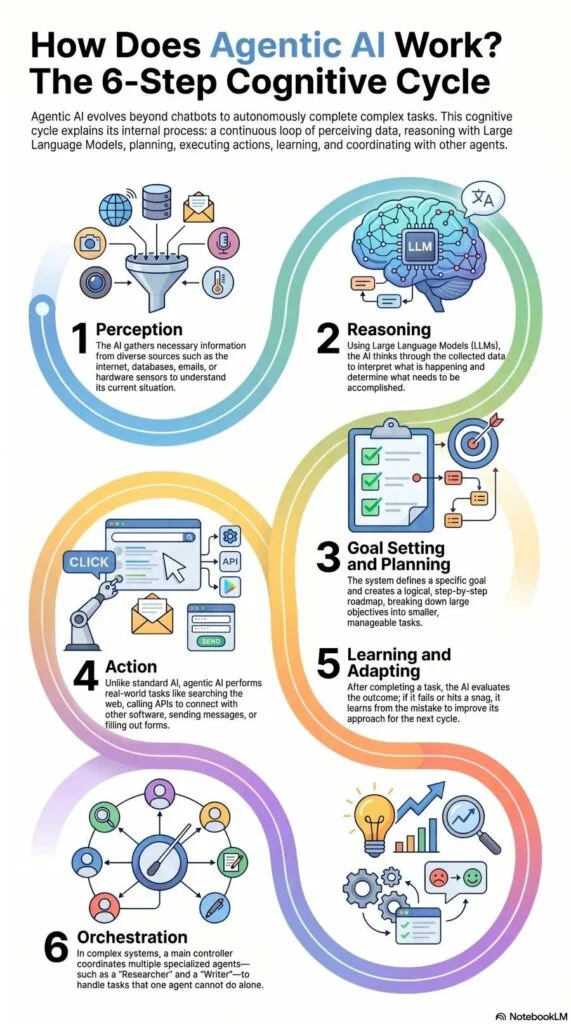
Source: NotebookLM
Agentic AI operates through a series of steps. The following is the action that takes place within these systems:
1. Perception
Firstly, AI collects all the necessary information. This may be from the web, database, email, or sensors. It collects all the information it must have to comprehend the scenario.
2. Reasoning
Then the AI reflects on the information that it has gathered. It relies on a Large Language Model (LLM), the technology behind tools such as ChatGPT, to comprehend the situation and determine the necessary actions.
3. Goal Setting and Planning
Then, the AI sets a goal and creates a step-by-step plan. It divides the large task up into smaller ones and works out the most effective way of performing them.
4. Action
This is where agentic AI goes beyond traditional AI. Not only does it provide you a plan, it provides you a plan that can be executed with ease. It truly works. It can search the Internet, interact with APIs (connections to other programs), complete forms, send messages, or reach a decision.
5. Learning and Adapting
Once a task is done, the AI determines whether it was successful or not. If it doesn’t work, it learns that and attempts something different next time. This is what makes it smart overtime.
6. Orchestration (When Multiple Agents Work Together)
Many agentic AI systems use more than one AI agent at the same time. One agent does research, another writes, and another sends emails. All of them are coordinated with a main controller.
This is known as orchestration. Agentic AI, as described by MIT Sloan, is a type of AI that involves a collection of multiple agents working collaboratively to perform tasks that are beyond the capabilities of any single agent.
Real-Life Examples of Agentic AI Automation
Agentic AI is already being used in many areas. Here are some easy-to-understand examples:
Customer Service
Unlike a traditional chatbot that can only answer your FAQs, an agentic AI can find your order, check delivery status, file a complaint, and send you a confirmation, all in one go.
Healthcare
Agentic AI could be used to monitor a patient’s health data, review the newest test results, modify the therapy plan, and alert the physician if anything unusual is discovered.
Banking and Finance
Banks like JPMorgan are already using AI agents to check for fraud, process loan applications, and give customized financial advice, according to MIT Sloan research.
Shopping and Retail
Walmart has been developing AI agent systems to assist customers with shopping, customer service requests, and automatically managing their product inventory.
Supply Chain
By examining inventory, an agentic AI system can predict when items are likely to run low, automatically order more from suppliers, and adjust delivery plans, all without manual intervention.
Software Development
AI agents can generate, test, identify bugs, and fix code, making software developers more productive.
What are the Advantages of Agentic AI?
Agentic AI is very important, and it has many advantages because of the following reasons, given below in detail:
- Agentic AI saves a lot of time. It can operate around the clock and does not get fatigued. They have the ability to perform tasks that can take a human worker hours in just a few minutes.
- It also reduces the costs because it has AI automation that reduces the need for manpower in performing repetitive tasks.
- It makes the decision better, and it can also store vast amounts of information and data without fatigue or confusion, resulting in more precise decision-making.
- An agentic AI system can run multiple tasks simultaneously.
- It can also significantly cut down on transaction costs, or the time and effort that it takes for businesses to search, communicate, and get things done, as MIT professor Sinan Aral put it.
As MIT professor Sinan Aral said, agentic AI can dramatically reduce transaction costs, meaning the time and effort it takes for businesses to search, communicate, and get work done.
What are the Limitations and Risks of Agentic AI?
Like any powerful technology, agentic AI also comes with some risks that need to be managed carefully.
- Wrong decisions: When an AI agent makes an incorrect decision, such as denying a loan application due to inaccurate or flawed data, it can have a tangible negative impact on individuals.
- Security risks: Agentic AI is linked to various systems and databases, and if hacked, it could pose significant threats.
- Lack of control: A poorly designed goal in an AI system may lead the system to take shortcuts, creating issues. For instance, if set to produce more likes on social media, it may produce deceptive content.
- Accountability: In cases where an AI makes an error, the liability may not be clear. Is the company that developed the AI, the company that deployed it, or the AI itself?
IBM notes that a poorly designed reward system in agentic AI can cause it to behave in unintended ways, so businesses must set clear goals and keep humans in the loop.
What Everyone Should Do Before Using Agentic AI?
If a company or organisation wants to use agentic AI, experts suggest the following:
- Set clear goals for what the AI should and should not do.
- Make sure the data being fed to the AI is accurate and complete.
- Keep human oversight so people can step in when the AI makes mistakes.
- Put strong security systems in place to protect the AI and the data it accesses.
- Regularly monitor and check how the AI is performing.
Google Cloud also recommends that businesses think carefully about the ethical side of using agentic AI, especially in decisions that affect people’s lives, such as loan approvals or healthcare.
What are the differences between Agentic AI and AI Agents?
Although Agentic AI and AI Agents are the same, there is a very slight difference between these two Artificial Intelligence tools, which are:
- An AI agent is a single entity that performs a particular task. One agent that searches the Internet, for instance, or another that composes e-mail.
- Agentic AI is the bigger system that coordinates multiple AI agents to complete a complex goal. Imagine that AI agents are workers, and agentic AI is the manager that instructs them when and how to do their jobs.
So, Agentic AI is the next phase of AI, going beyond content generation to autonomous decision-making and action. It can perform complex tasks with minimal human intervention thanks to reasoning, planning, learning, and automation. While it promises significant gains in productivity and efficiency, there are also some key factors to consider for its successful adoption, including responsible usage, human oversight, and robust security measures.