



China is emerging as a leader in the humanoid sector, with new companies launching every few weeks. China’s robotics program has led to the development of improved humanoid models. Therefore, the nation is closing the gap with Western leaders and surpassing them in different areas. To explain, we’ll explore the top 10 Chinese Humanoid robots, their current applications, and their growing importance.
Also Read: Top 10 Robotics Skills Required for Engineering Career Growth
Best 10 Chinese Humanoid Robots in 2026
China is making a buzz in the robotic world nowadays, and its introduction of humanoid robots has set the bar high. As the service robotics market is forecasted to generate US$7.37 billion revenues in 2018, these top 10 Chinese humanoid robots are making waves.
- D9

Source: pudurobotics
The Pudu X9 D9 biped robot is ideal for service and logistics functions. It applies new technology and structural stability to boost industrial operations within a short timeframe. Thanks to its autonomous routing technology, it can navigate and perform operations in small indoor spaces.
- Flashbot Arm

Source: yankodesign
Flashbot Arm manipulates and delivers with precision. It is highly effective in various environments, including hotels and offices, and exhibits sophisticated sensing, mobility, and coordination capabilities. It is highly scalable and adaptable due to its modular structure, which enables quick integration with existing service systems.
- Unitree G1 Robot

Source: nowadais
Unitree G1, a humanoid robot from Unitry, is an economical and user-friendly robot. It is intelligent and efficient at running, jumping, and doing things just the way you like them to be done. Because it features an efficient gait mechanism and real-time synchronization, it is ideally suited for both learning and amusement.
Also Read: Top 11 Robotics Blogs and Websites to Follow in 2025
- K2
It has the most advanced hardware and AI technology. Besides, it is particularly excellent for precision engineering in manufacturing and shipping, as it is capable of withstanding a significant amount of weight and precisely sensing its environment. It is multi-modal sensing simplifies the process of acclimating to production changes, thereby enhancing safety and efficiency in repetitive tasks.
- Adam Lite

Source: interestingengineering
PND Robotics created the Adam Lite, a humanoid robot that can walk and interact in different ways in different places. This solution combines agility with cutting-edge AI technology to ensure operations run smoothly and efficiently, handling a wide range of tasks across both industrial and service sectors.
- Walker S1
The Walker S1 serves industrial operations. It features autonomy, navigation systems, and adaptive movement, making it suitable for tasks such as quality inspections and parcel sorting. It can function continuously in dynamic manufacturing conditions with minimal monitoring due to its balanced mobility.
- Xiaomi CyberOne
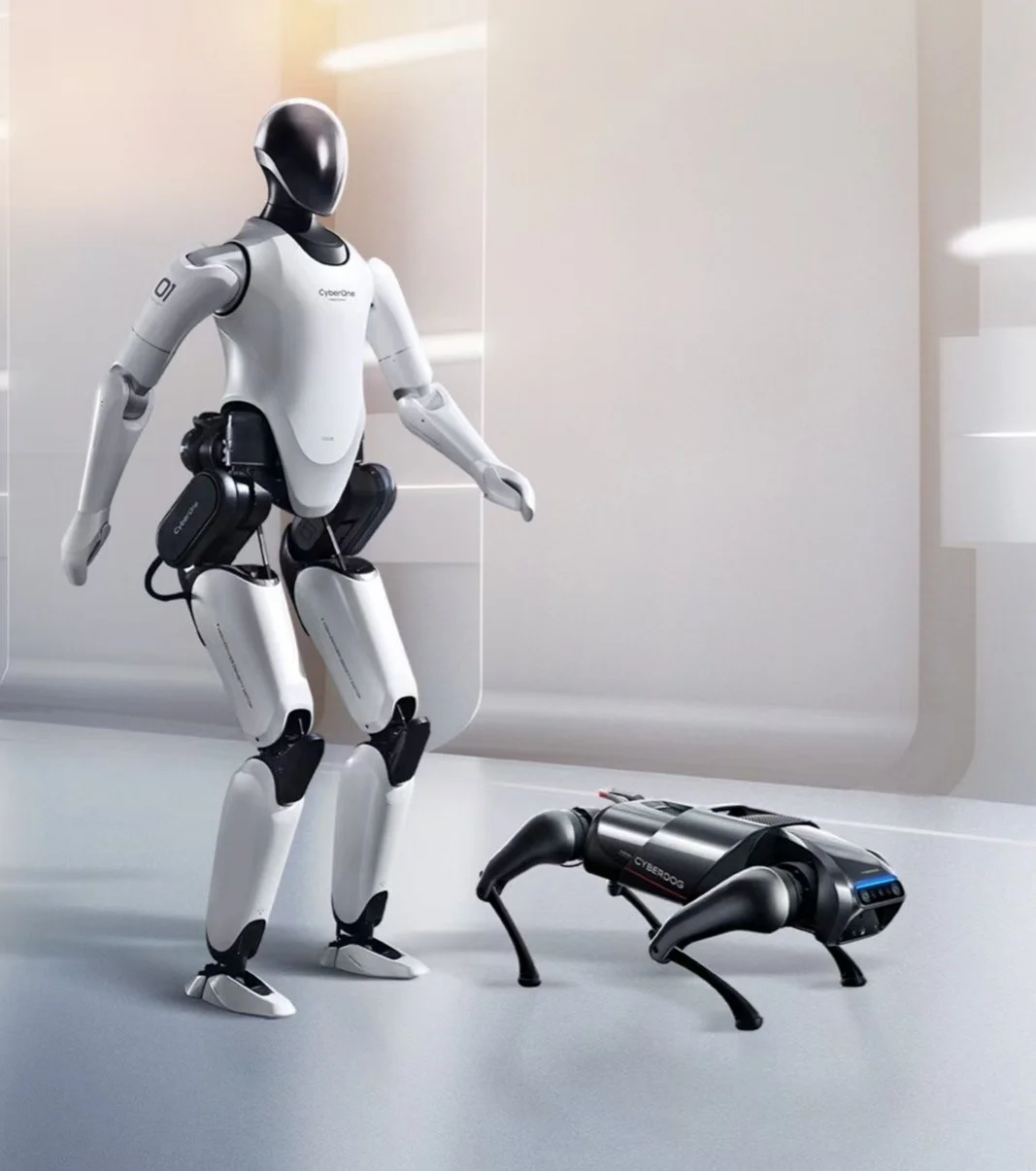
Source: X.com/CyberOne
Xiaomi CyberOne is notable for its emotional intelligence. It truly stands out in this regard. CyberOne, equipped with vision, torque-controlled joints, and emotion recognition, excels in customer service and smart-home settings. It provides responsive and individualized user interactions by interpreting speech tones and facial emotions.
- Magic Bot
The Magic Bot exhibits movement and dexterity comparable to that of humans. It has the potential for use in both industrial tasks and everyday activities and interactions. It can carry out a variety of activities that demand accuracy and flexibility due to its adaptable limbs and object recognition capabilities.
- Ironman Robot
The Ironman robot provides outstanding mobility. It also integrates AI for industrial automation tasks, utilizing neural networks, reinforcement learning, and agile movement. It can operate continuously in industrial facilities, warehouses, and active outdoor areas thanks to its sturdy construction and energy efficiency.
- PMO1 Robot
The PMO1 is a portable and agile robot. It features advanced AI and motion-capture technologies that enable it to mimic environments, demonstrating its potential applications in the fields of AI research and robotics. Its compact size and fast response time make it ideal for experiments on how humans and robots interact in laboratories.
Also Read: Optimus Robot by Tesla: Bold Features, Potential Impact, and Upcoming 2025 Launch
Current Applications of Chinese Humanoid Robots
In addition, these robots are not only the subject of research initiatives; instead, they are being put to use in a variety of industries, including:
- Manufacturing & Logistics
Lines of manufacturing are made more efficient by Iron and Walker S1 machines. Similarly, Pudu’s D9 is responsible for carrying out logistics, restocking, and cleaning in retail locations and warehouses.
- Public Events & Entertainment
University teams set up completely autonomous humanoid football games to test their ability to perceive and coordinate in real time. Unitree’s H1 robots demonstrated their capabilities by dancing with people at large parties.
Also Read: Jet-Powered Humanoid Robot iRonCub: IIT’s Revolutionary Leap in Robotics
- Hospitality & Service
Some humanoid utilizes adaptive perception in the hospitality and service industry. It navigates hotel hallways, performs cleaning tasks, and restocks amenities efficiently, enhancing both operational productivity and the guest experience through autonomous, intelligent interaction.
- Research & Sports Testing
Tien Kung Ultra pushed the battery life and endurance standards to their limits by successfully finishing a 13-mile marathon. Similarly, the flips performed by EngineAI and the recoiling hops performed by Tiangong also emphasize dynamic balance.
- Home and Companion Roles
Xiaomi’s CyberOne small units can potentially perform emotion detection and instructional activities, even though they are not yet widely used in residential settings.
- Safety and Monitoring
These days, some humanoid robots include motion sensors, face recognition, and real-time alarm systems. By patrolling business complexes, keeping an eye on restricted areas, and reporting suspicious activity, these robots improve security and lessen the need for human guards.
Also Read: Discover the AI-Powered Robots Big Tech Believes Will Solve the Global Labor Shortage
Importance of Chinese Humanoid Robot
A machine that mimics the shape and motion of the human body is called a humanoid robot. However, Chinese humanoid robots are unique because of two essential features.
- First, they have in-house hardware that combines sophisticated actuators, vision modules, gait control systems, and dexterous manipulators. These are designed to prioritize functional stability and mechanical accuracy.
- Second, advanced artificial intelligence systems drive them, often utilizing neural models that integrate real-time decision-making, reinforcement learning, and vision-language capabilities. Researchers often employ large datasets to train these intelligent systems, which makes them more effective and flexible.
Strong government support, including subsidies and targeted research grants, has also played a significant role in this increase. Large-scale manufacturing initiatives in China designed for industrial use have also enabled the country to make rapid progress in this area. These projects seek to make China more self-sufficient in technology.
Conclusion
Within a few years, Chinese humanoid robots have quickly progressed from prototypes to actual workers. China is now generating more than half of the world’s humanoids. This is due to its industrial prowess in manufacturing, strong government support, and advancements in artificial intelligence.
In the future, these robots are likely to integrate further into everyday settings. It will assume more responsibilities in personal assistance, retail, healthcare, and eldercare.
For more information on Robotics and AI, click on the links given below: