Read here the features of Unitree's G1 and Boston Dynamics' Atlas and how they perform in various tasks. This article will also cover which robot is better suited for different applications based on their capabilities.
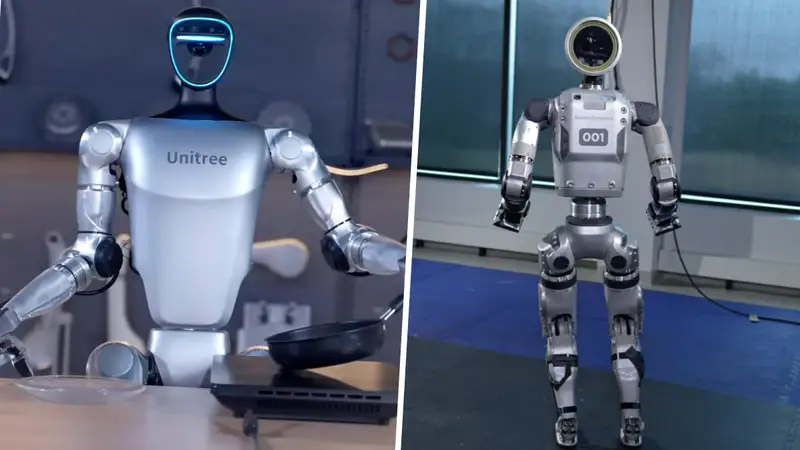
Unitree G1 vs. Boston Dynamics Atlas
The world of humanoid robots keeps on developing. Unitree’s G1 and Boston Dynamics’ Atlas are two of the most advanced humanoid robots on the market. Both robots showcase impressive capabilities in terms of agility, hypermobility, and overall functionality.
The Unitree G1 is a robotic dog developed by Chinese startup Unitree Robotics. Unveiled in 2023, G1 is designed for various purposes, including service, security, education, and entertainment. Atlas is a humanoid robot developed by Boston Dynamics. It displays impressive feats of strength, agility, and dynamic movement.
While both G1 and Atlas are impressive robots with advanced capabilities, there are a lot of differences between the two of them. In this article, we will explore those differences.
Top 13 Humanoid Robots You Watch and How They Work
G1 is a small robot from China that is only 4 feet 2 inches tall but has more agility than you might imagine. Its ability to bend in many places and being light are the reasons behind this. It can fold its body like a contortionist, doing difficult actions such as opening a soda bottle or even walking on a tightrope.
Whereas, Atlas is American-made, measuring 5 feet 9 inches and showing strong power with its appearance. But do not be tricked by its size. Atlas uses sophisticated hydraulics to perform dynamic movements that are truly amazing. It can easily move on rough surfaces, jump over hurdles with daring leaps, and even do backflips with impressive steadiness.
Here are some of the key differences between the two
The G1 places importance on flexibility that cannot be matched. Many joints and its smaller size give it the ability for delicate movements and the exact handling of objects. On the other hand, Atlas focuses more on strength as well as quickness or nimbleness. Even though it can do amazing acrobatics, the main skill of this robot is to move around in changing places and complete strong duties.
The G1’s hypermobility stems from a servo-driven system, offering unparalleled control over its limbs. Whereas, Atlas utilizes hydraulics, generating the power needed for its dynamic movements but adding bulk to its design.
The G1 uses advanced algorithms to grasp the surroundings and plan its actions accordingly, making it very intelligent in adapting to different situations. Atlas also possesses similar abilities for understanding objects and responding swiftly based on its environment’s data.
The energy source for the G1 is a strong battery pack located within its body frame. In comparison, Atlas utilizes high-capacity batteries placed throughout its structure evenly.
The communication method of the G1 is through Wi-Fi connection or direct link with another device using a cable wirelessly. For Atlas, it can send signals by using Ethernet or USB connections as well as Wi-Fi like the G1.
In terms of battery life, the G1 can function for about 2 hours while Atlas is limited to around 1 hour and 30 minutes.
Top 11 Robotics Competition for Kids and Students 2024
The G1 is superior in contortion and dexterity, but the Atlas leads with brute strength and outdoor navigation.
In the end, the better of the two humanoid robots is decided by the type of application. The future of robotics is not about one design taking over everything, but a variety of robots with their unique hypermobility specialization. They are going to work together with humans to create better days ahead.
Top 10 Robotics YouTube Channels to Learn and Grow in 2024
This post was last modified on May 27, 2024 7:03 am
Pick your task, get the best AI model for it — images, video, slides, research,…
Learn what Agentic AI is, how it works, and how it differs from Generative AI.…
Discover the 13 best free online vocal remover AI tools for 2026, designed to isolate…
Explore the top 13 yield farming platforms for 2026, featuring secure, trusted, and high-APY crypto…
Explore the best AI learning platforms for 2026, including Coursera, edX, Udacity, and more. Learn…
Explore the 13 best Polygon wallets in 2026, comparing security, DeFi access, hardware and mobile…