Nvidia has released its open-source AI base model, the Nvidia Isaac GR00T N1, which powers humanoid robots. The model uses synthetically created data and pre-existing datasets, allowing for fast and slow thinking, enabling vision and reasoning-based decision-making in humanoid robots.
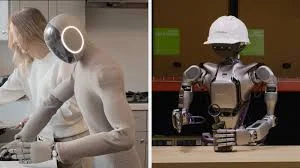
Nvidia introduces Groot N1, an AI model that will drive the next generation of humanoid robots
Nvidia has declared the public release of its open-source, pre-trained AI base model, which powers humanoid robots.
The Nvidia Isaac GR00T N1, also known as the Groot N1, is the “generalist” model. It was unveiled on Tuesday, March 18, during the chip giant’s highly anticipated annual GTC conference in San Jose, California, in the United States.
Nvidia CEO Jensen Huang declared that “the age of generalist robotics is here” during his keynote speech at GTC 2025. He continued that robotics developers worldwide will unlock the next frontier in the era of artificial intelligence with the Nvidia Isaac GR00T N1 and new data-generation and robot-learning frameworks.
Also Read: NVIDIA Reveals Its Most Inexpensive Supercomputer for Generative AI
Both synthetically created data and pre-existing datasets were used to train the AI fundamental model. Nvidia added that the simulation frameworks and designs for creating artificial training data will be available to the public.
Mass-produced, all-purpose robots that move like people are becoming a feasible objective shortlyx thanks to the development of generative AI, which has also sparked innovation in humanoid robotics.
Larger firms like Nvidia and Google have placed bids to supply the underlying AI technology that powers humanoid prototypes, while smaller firms like X1 and Figure are focusing on improving and scaling them. Google DeepMind recently unveiled Gemini Robotics, a collection of AI models intended to give robots the precision and agility they need to do challenging jobs.
Also Read: Nvidia Fugatto Text to AI Sound Model: Features, Use Cases, and Other Details
Nvidia claims in a video on its YouTube channel that the Groo N1 has a “dual-system architecture” that allows it to “think fast and slow” and is modeled after human intellect. According to the trillion-dollar corporation, humanoid robots with vision and reasoning abilities will be able to make the correct decisions thanks to Groot N1’s slow-thinking system.
Also Read: NVIDIA Shares Omniverse Real-Time Physics Digital Twins With Leading Software Companies
However, according to Nvidia, the model’s fast-thinking system will assist in swiftly converting the intended actions into robotic movements that involve moving objects across a number of steps.
The culmination of Nvidia’s Project Groot, which the firm unveiled at last year’s GTC conference, is Groot N1.
This post was last modified on March 22, 2025 1:18 am
Pick your task, get the best AI model for it — images, video, slides, research,…
Learn what Agentic AI is, how it works, and how it differs from Generative AI.…
Discover the 13 best free online vocal remover AI tools for 2026, designed to isolate…
Explore the top 13 yield farming platforms for 2026, featuring secure, trusted, and high-APY crypto…
Explore the best AI learning platforms for 2026, including Coursera, edX, Udacity, and more. Learn…
Explore the 13 best Polygon wallets in 2026, comparing security, DeFi access, hardware and mobile…